Pages

Showing posts with label Dragons. Show all posts

Thursday, September 4, 2025

Saint Anthimos the Serpent-Hunter of Kefallonia


Venerable Anthimos Kourouklis, the Blind Ascetic of Kefallonia, who reposed on September 4th 1782, is also associated with the Greek island of Astypalea where he did missionary work and performed a number of miracles. It was here that he helped exterminate a huge serpent that nested in a small cave in the northeast of the island, known to this day as Drakospilia or Drakontospilaio (translated as Dragon Cave).

The serpent instilled such fear in the inhabitants that the entire area beyond the narrow part of the island was uninhabited. The Saint advised them to cultivate the rest of the island in order to survive; however, he encountered their resistance due to the serpent. Then Anthimos, accompanied by a few faithful witnesses to the remarkable miracle that followed, crossed the narrow passage of the island and reached an elevation from where the cave of the dragon could be discerned.

Wednesday, July 26, 2023

The Church of Saint Paraskevi of the Dragon in Arta of Epirus


The Church of Saint Paraskevi of the Dragon is located 11 kilometers north of Arta in Epirus, above the settlement of Ampelia Ammotopou and 2 kilometers approximately northeast of the provincial road Artas-Hanopoulos-Ammotopou. Isolated in the southern area of Xirovouni, on the smooth slopes of Gelperina, it connects its establishment with the adjacent cave or "dragon hole" as the locals call it.

The legend of the building of the temple, as well as the nickname "of the dragon", is based on the well-known and particularly popular theme of dragon slaying which symbolizes the victory over evil, most popularly associated with Saint George.

According to folk tradition, a dragon lived in the cave, which once a year appeared at the village festival and grabbed the most beautiful maiden. The inhabitants begged Saint Paraskevi to free them from this evil, so the Saint clashed with the monster and killed it. In her honor, the residents erected the small church.

Thursday, March 31, 2022

Saint Hypatios of Gangra and the Dragon


During the reign of Emperor Constantius II, son of Saint Constantine the Great, when he ruled over the entire Roman Empire after 353 AD, a dragon took up its habitation in the imperial treasury. Because of this, no one dared enter the chamber, and therefore the treasury became inaccessible, for the great serpent lay its head right next to the door. Those who dared enter were immediately slain by the fierce serpent.

Not knowing what to do, Emperor Constantius called for Bishop Hypatios of Gangra, who was known widely for his miraculous powers. Despite the danger, Saint Hypatios went to Constantinople to show the emperor the power of God.

Tuesday, December 28, 2021

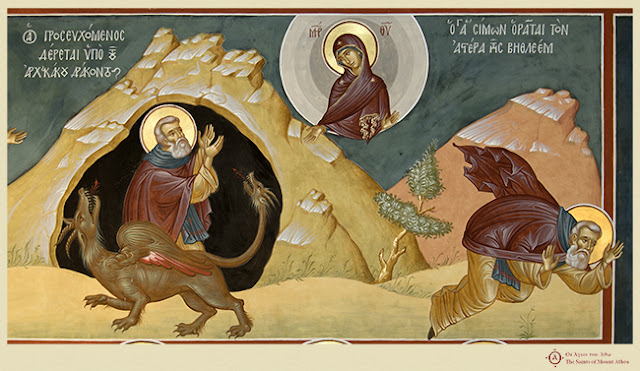
Saint Simon the Myrrhgusher and the Dragon


When Saint Simon departed from his elder, he traveled throughout the Holy Mountain of Athos in search of a suitable place where he could settle and dwell in quietude and obscurity. After considerable searching, he found a cave. Here he armed himself with faith, patience, prayer and fasting, and faced demonic temptations to a degree like he never faced before.

Monday, October 18, 2021

The Dragon of Mega Spelaion


Mega Spelaion, or Great Cave, is a large cave near Kalavryta, in the Peloponnese peninsula in southern Greece. Today a monastery is there known as the Monastery of Mega Spelaion, because according to tradition, it was in this cave that the Apostle Luke lived while evangelizing the area, and where he also wrote his Gospel and made one of his first icons of the Mother of God. Many centuries later two brothers who were monks, Saints Symeon and Theodore, found this miraculous icon with the help of a local shepherdess Saint Euphrosyne in the cave and a monastery was established. However, after the two brothers found the icon, deep within the cave, unknown to them, it is said there lived a dragon.

Monday, April 30, 2018

The Bones of a Dragon Killed by Saint Donatos in the Fourth Century


The following account was written concerning Saint Donatos (Apr. 30), a late fourth century bishop from Albania, by the fifth century historian Sozomen (Eccl. Hist., Bk. 7, Ch. 26):

"There were at this period many other bishops in various parts of the empire highly celebrated for their sanctity and high qualifications, of whom Donatos, Bishop of Euroea in Epirus, deserves to be particularly mentioned. The inhabitants of the country relate many extraordinary miracles which he performed, of which the most celebrated seems to have been the destruction of a dragon of enormous size. It had stationed itself on the high road, at a place called Chamaegephyrae and devoured sheep, goats, oxen, horses, and men. Donatos came upon this beast, attacked it unarmed, without sword, lance, or javelin; it raised its head, and was about to dash upon him, when Donatos made the sign of the cross with his finger in the air, and spat upon the dragon. The saliva entered its mouth, and it immediately expired. As it lay extended on the earth it did not appear inferior in size to the noted serpents of India. I have been informed that the people of the country yoked eight pair of oxen to transport the body to a neighboring field, where they burnt it, that it might not during the process of decomposition corrupt the air and generate disease... The inhabitants of Isoria, a village in the territory of Euroea, bear testimony to the truth of this narration."

Monday, November 20, 2017

The Christian History of the Gargoyle

Gargoyles and Saints of Siena Cathedral

In architecture, a gargoyle is a carved or formed grotesque with a spout designed to convey water from a roof and away from the side of a building, thereby preventing rainwater from running down masonry walls and eroding the mortar between. Architects often used multiple gargoyles on buildings to divide the flow of rainwater off the roof to minimize the potential damage from a rainstorm. A trough is cut in the back of the gargoyle and rainwater typically exits through the open mouth. Gargoyles are usually an elongated fantastical animal because the length of the gargoyle determines how far water is directed from the wall. When Gothic flying buttresses were used, aqueducts were sometimes cut into the buttress to divert water over the aisle walls.

Monday, July 17, 2017

How Saint Marina (Margaret) Became a Patron Saint of Pregnant Women and Childbirth


Saint Marina is known as Saint Margaret in the West. Whereas Saint Marina has always been highly esteemed and enjoyed wide popularity among Orthodox Christians of the East, in the West it was not always so. Her Acts were declared apocryphal by Pope Gelasius I in 494, but devotion to her revived in the West with the Crusades. Margaret is one of the Fourteen Holy Helpers, and thus one of the saints who is said to have spoken to Joan of Arc, thus increasing her veneration among the people. According to the Roman Martyrology she is celebrated on July 20, as opposed to July 17 in the East. Pope Paul VI in 1969 removed her from the list of saints because of what was considered the entirely fabulous character of the stories told of her and thus disputing her historical existence.

Tuesday, July 26, 2016

Saint Paraskevi and the Dragon


In the Life of Saint Paraskevi we read how she entered a certain city outside the Roman Empire to evangelize the people there. The ruler of this city was King Asklepios, who when informed of her activities had her arrested and brought before his judgment seat. After inquiring what brought her to their city, she boldly confessed that she was a Christian and proclaimed Christ as the true God who made heaven and earth and in these latter days was incarnate, crucified and resurrected for our salvation. At the same time she denounced the soulless idols of paganism, quoting from the Prophet Jeremiah: "Let the gods which have not made heaven and earth perish from off the earth, and from under the sky" (Jer. 10:11).

Sunday, August 9, 2015

The Miraculous Holy Spring of Saint Myron and the Dragon

Holy Spring of St. Myron

From August 7th through the 8th every year thousands of pilgrims from all over Crete descend on the town of Agiou Myrona to celebrate the memory of their patron saint, Saint Myron the Wonderworker, who was Bishop of Crete in the fourth century. There they enter the church dedicated in his honor, they light a candle, venerate his recently discovered relics, and kiss his holy icon. Besides these things, they also go to the spring of St. Myron, located beneath his tomb, to drink from its miraculous waters.

Friday, July 17, 2015

Can Demons Suffer Physical Harm?


By John Sanidopoulos

Some have asked how is it that demons or evil spirits can suffer as we do in the body, citing St. Paul who wrote: "For our battle is not against flesh and blood, but against principalities, against powers, against the rulers of this dark age, against the spiritual hosts of wickedness in the heavenly places" (Eph. 6:12).

Thursday, April 23, 2015

Why Saint George is Often Depicted Slaying a Dragon


By John Sanidopoulos

The well-known story of St. George killing the dragon is obviously a legend and not a fact of history, since dragons do not exist, unless we are speaking of the Komodo dragon, but it is unlikely the Komodo dragon would appear in the Middle East from Indonesia and pose the threat described in the tale.

The depiction in iconography of St. George as a dragonslayer is purely symbolic art, and this story is nowhere to be found in the rich hymnography of the Orthodox Church, which references the most realistic elements of the lives of the saints. For example, often in iconography we see St. John the Baptist depicted with wings, but this illustration is purely symbolic of him being an earthly angel and divine messenger. Another example is the depiction of halos around the heads of the saints, which is symbolic of their heavenly citizenship and the Divine Light of their deification and their being filled with the grace of the Holy Spirit.

Sunday, March 8, 2015

St. Paul the Simple Battles a Powerful Demon

St. Paul the Simple (Feast Day - March 7 and October 4)

By Palladius of Helenopolis 
(Lausiac History, Ch. 28)

The great and blessed Anthony had become convinced that the soul of this servant of Christ had become almost perfected in all things, even though he was somewhat simple. After a few months Anthony was moved by the grace of God to build a cell for him three or four miles away from his own cell, and said to him, "See now, by the help of the grace of Christ you have become a monk. Now live by yourself, and even take on the demons."

So a year after Paul the Most Simple came to live with him he was highly experienced in a disciplined way of life and was found worthy to battle against the demons and against all kinds of diseases.

Wednesday, January 7, 2015

The Baptism of Christ and Demonology


By St. Cyril of Jerusalem

Jesus sanctified Baptism by being Himself baptized. If the Son of God was baptized, what godly man is he that despises Baptism? But He was baptized not that He might receive remission of sins, for He was sinless; but being sinless, He was baptized, that He might give to them that are baptized a divine and excellent grace. "For since the children are partakers of flesh and blood, He also Himself likewise partook of the same" (Heb. 2:14), that having been made partakers of His presence in the flesh we might be made partakers also of His Divine grace: thus Jesus was baptized, that thereby we again by our participation might receive both salvation and honor.